
Careers Adda offers a well-structured and student-friendly CUET English Free Mock Test 2026 to help aspirants prepare in a smart and focused way. Our mock test series is created according to the latest CUET exam pattern and includes key topics like reading comprehension, vocabulary, grammar, and verbal ability. With easy-to-check answer keys, students can track their progress, find weak areas, and improve step by step. These free tests are perfect for daily practice, better time management, and building strong confidence for the real exam.
CUET English Free Mock Test
Practice smarter with Careers Adda’s CUET English Free Mock Test designed for serious exam preparation. It helps students improve reading skills, vocabulary, grammar, and overall accuracy. Each test comes with answers so you can quickly check your performance. Start free practice with Careers Adda and move closer to your CUET success.
Best CUET English Free Mock Tests
Find the best CUET English free mock tests at Careers Adda for effective and exam-ready preparation.Our tests are simple to attempt, updated with the latest pattern, and useful for regular revision.They help boost speed, confidence, and question-solving ability before the actual exam.Choose Careers Adda for quality mock tests that support better CUET English scores.
CUET English Previous Year Questions
Directions (1- 4) Read the given passage and answer the four questions that follow:
The next stage of the visit began as Mrs. Broadwith brought in a cup of tea and the rest of the animals were let out of the kitchen. It was the usual scenario for the many cups of tea I had drunk with Miss Stubbs under the little card which dangled above her bed.
“How are you today?” I asked.
‘Oh! much better,’ she replied and immediately changed the subject.
Mostly she liked to talk about her pets and the ones she had known right back to her girlhood. She spoke a lot too, about the days her family was alive. She loved to describe the escapades of her three brothers and today she showed me a photograph which Mrs. Broadwith had found.
‘Oh, they were young rips!’ she exclaimed. She laughed and for a moment her face was radiant, by her memories.
The things I had heard in the village came back to me; about the prosperous father and his family who lived in the big house once. Then the foreign investments crashed and the sudden change in circumstances. ‘When the old father died, he was almost penniless,’ one old man said. ‘There is not much brass there now.’
Probably just enough brass to keep Miss Stubbs and her animals alive and pay Mrs. Broadwith. And, sitting there, I felt as I had often – a bit afraid of the responsibility I had. The one thing which brought some light into the life of the brave old woman was the devotion of this shaggy bunch whose eyes were never far from her face.
Q1. “There’s not much brass there now” — the underlined word refers to:
(a) brass ware (b) musical instruments
(c) money (d) metal
Q2. Identify the meaning of the underlined word in the following sentence by selecting the best option:
“She loved to describe the escapades of her three brothers…”
(a) grave acts (b) funny acts
(c) serious sober acts (d) mischievous acts
Q3. Miss Stubbs led a very simple life because ______.
(a) She didn’t believe in leading a luxurious life
(b) She was too sad a person to enjoy simple pleasures of life
(c) she couldn’t afford even the normal little luxuries
(d) she was bed-ridden and bitter about it
Q4. Which among the following was not a topic of Miss Stubbs’s conversation?
(a) her brothers
(b) her pets
(c) her past with her family
(d) her classmates
Comprehension:
Directions (5 – 8) Read the given passage and answer the four questions that follow:
If my younger self could see me now, she would be incredulous. That I work in the field of dance or decipher and translate dance for my own comprehension, call it choreography if you wish, would have been unbelievable. In this respect, I am particularly envious of dancers who claim that they are ‘born to dance’, implying that it was clearly laid out for them from the beginning. I must say, I find this assertion dubious; it is rarely that easy. To ‘dance’ means ‘to struggle’.
In all truth, as a child, I never did want to dance; it was forced upon me by a doting mother and a silent father. My father probably kept his peace to avoid argument. From the beginning, my lessons took place under trying conditions, though I believe that the conditions were more trying for my mother than for me. She travelled in local, over-crowded trains to the dance class with an unwilling child, tired from a whole day at school.
Interestingly, when I was seven, we went to see a movie starring Mumtaz Ali, who did a dance number in the film. When we arrived home, I began prancing around the house imitating the film actor and my mother, who was quietly watching, was the one who said, ‘Kumudini, you are born to dance.’ Ironically, I have no recollection of this story; it was my mother who saw this innate ability in me.
Q5. What role did her father play in her becoming a dancer?
(a) He gave his passive disapproval
(b) He was indifferent
(c) He was actively involved.
(d) He tried maintaining a harmonious atmosphere.
Q6. The narrator says, ‘to dance means to struggle’ as she _____.
(a) was envious of the other dancers’ talent.
(b) had tough time convincing her parents about her passion
(c) doesn’t have good memories of her childhood
(d) had to work hard to perfect the art, though unwillingly
Q7. The seeds of the narrator’s future vocation were sown when she _______.
(a) went willingly to the dance class
(b) pranced around the house imitating the dance steps from a movie
(c) was born with an innate ability to dance
(d) was encouraged by her father to take up dancing
Q8. The narrator’s younger self would be incredulous if she saw the narrator now, as:
(a) she had become a choreographer.
(b) she couldn’t decipher the nuances of dance.
(c) she was too curious to learn dance since her early childhood.
(d) her reality and her dreams were not bridged.
Comprehension:
Directions (9 – 12) Read the passage and answer the four questions that follow:
The State of Food Security and Nutrition in the World report (2024) revealed that 733 million people faced malnutrition in 2023—an increase of 152 million since 2019.
This trend is linked to food price dynamics. In 2022, the World Bank estimated that a 1% rise in global food prices could push 10 million people into extreme poverty. Rising food costs and inequality have intensified “hidden hunger,” affecting at least 2.8 billion people in 2022 alone.
Hidden hunger is a deficiency of essential micronutrients like zinc, iodine, and iron. The signs of this form of malnutrition are ‘hidden’ as individuals may appear healthy while suffering severe health impacts. Clinical signs emerge only in extreme cases. Traditionally linked to caloric deficiency, hunger is now recognized to include micronutrient inadequacy, which can harm health even without overt signs of disease.
The Food Security and Nutrition report highlights that while it may seem intuitive that food-insecure individuals are less likely to maintain a healthy diet, the relationship is complex, shaped by factors like food environments, consumer behaviour, and the affordability of nutritious foods.
In some cases, food insecurity is linked to lower consumption of all food types and a higher reliance on staple foods for dietary energy. In others, it can be associated with reduced intake of nutritious foods and increased consumption of energy-dense foods high in unhealthy fats, sugars, and salt. As a result, food insecurity and “hidden hunger” can result not only in undernutrition but can also lead to overweight and obesity.
Q9. How can food insecurity paradoxically contribute to obesity?
(a) by causing people to eat excessive amounts of protein.
(b) by encouraging over consumption of cheap, unhealthy energy-dense foods.
(c) by limiting access to all food types, reducing overall consumption.
(d) by increasing the availability of nutrient-rich food in low-income areas.
Q10. What is the primary distinction between “hidden hunger” and traditional caloric deficiency?
(a) Hidden hunger refers to a lack of protein, whereas caloric deficiency refers to a lack of fats.
(b) Hidden hunger is caused by excessive food intake, whereas caloric deficiency is caused by food scarcity.
(c) Hidden hunger involves not so obvious micronutrient deficiencies, while caloric deficiency has visible symptoms.
(d) Hidden hunger is a short-term condition, whereas caloric deficiency affects only long-term health.
Q11. Which factor complicates the relationship between food insecurity and diet quality?
(a) The absence of global food production data.
(b) The overreliance on scientific studies rather than real-world evidence.
(c) Variations in food environments, consumer behaviour, and affordability.
(d) The assumption that food insecurity always results in undernutrition.
Q12. What consequence does the World Bank estimate of a 1% rise in global food prices?
(a) A decline in global malnutrition rates.
(b) A reduction in food insecurity through economic growth.
(c) An increase of 10 million people towards extreme poverty.
(d) No significant impact on food security.





 CBSE Compartment Exam 2026: Rules, Dates...
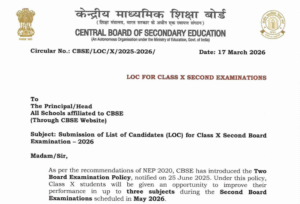 CBSE Class 10th Phase 2 Board Exams 2026...








 Call
Call 




