
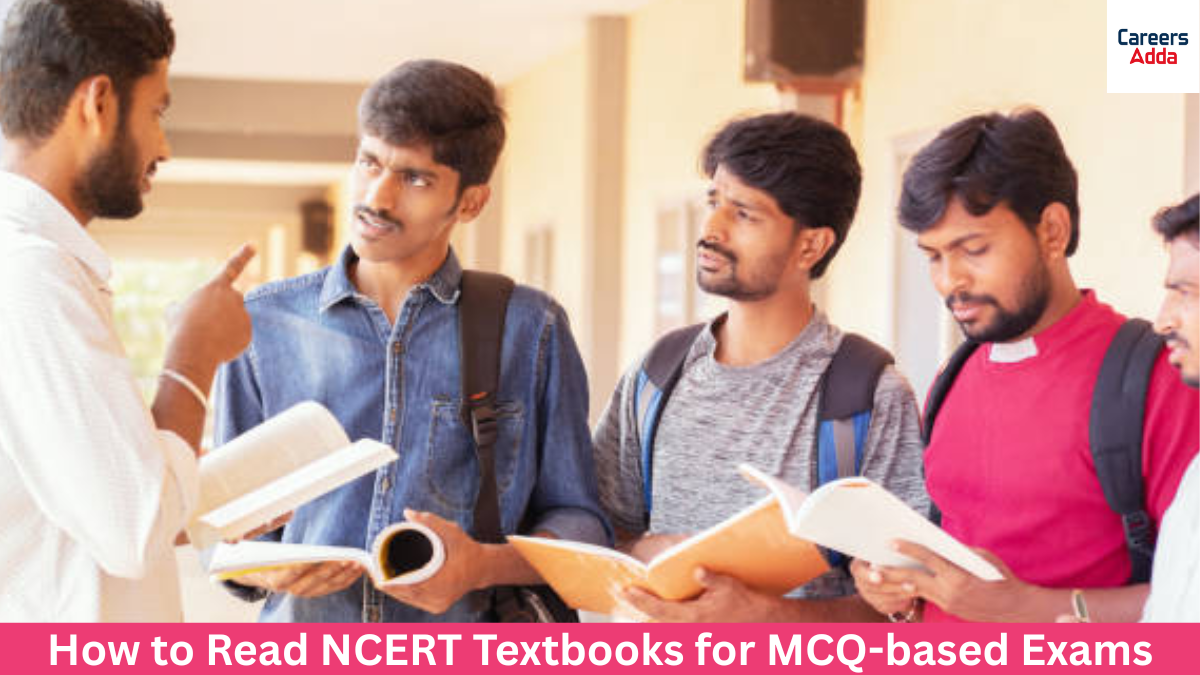
If you are preparing for the Common University Entrance Test (CUET UG) and wondering whether your NCERT textbooks are enough the answer is yes, but only if you read them the right way. Most students make the mistake of casually flipping through chapters and assuming they are prepared. But CUET UG is a fully MCQ-based exam and it tests your reading precision not just your general understanding. CUET UG domain subject syllabus is directly mapped to NCERT Class 11 and 12 content. Go through the page to know more about how to Read NCERT Textbooks for MCQ based Exams.

Match CUET UG Syllabus with NCERT Chapters
The very first thing applicants must do before opening any NCERT book is to refer the official CUET UG syllabus for your chosen domain subjects. CUET UG only tests candidates based on Class 12 NCERT content for domain subjects and in some cases Class 11 NCERT as well. Not every chapter in your textbook carries equal weight. Some units appear more frequently in the question paper than others. By mapping the syllabus first applicants can label each chapter as high priority, medium priority or low priority. This simple exercise ensures you spend your time where it is required.
Read NCERT Line by Line for CUET UG Preparation
CUET UG questions are mostly based directly on NCERT textbooks so reading each chapter carefully is very important. Many MCQs are framed from exact lines, definitions, and small details mentioned in NCERT. While studying pay close attention to bold terms, tables, summary points, examples, and diagram labels in the NCERT. These sections are commonly used to create questions in CUET exam. Develop the habit of reading NCERT line by line will help you understand concepts better and avoid missing important details.
Follow a Stream-Wise NCERT Strategy for CUET UG
CUET UG preparation should follow a stream specific NCERT approach. Science students must focus on concepts, formulas, reactions and diagram labels, especially in Biology. Commerce students should carefully learn definitions, terminology, and numerical formats from Accountancy and Economics. Humanities students need to remember dates, thinkers, constitutional articles, maps, and data tables. No matter the stream, always practice NCERT end-of-chapter questions to strengthen concepts for CUET MCQs.
Practice CUET-Style MCQs After Every Chapter
Do not wait until the end of the syllabus to start MCQ practice for CUET UG. After finishing each chapter, solve 20–30 CUET-style questions to check your understanding immediately. Focus on previous year CUET questions whenever possible, as many are based directly on NCERT lines. If you make a mistake revisit the exact concept in NCERT and mark it for revision. This habit improves accuracy and builds strong exam-oriented preparation.
Revise Smartly with Short Notes for CUET UG
Instead of re-reading full NCERT books multiple times, create short and clear revision notes while studying. Include definitions, formulas, keywords, important dates and tricky concepts in simple bullet points or mind maps. These notes make revision faster and more effective before the exam. Follow a three-step revision rule — within 24 hours, after one week, and before the exam. Consistent revision combined with MCQ practice helps improve CUET scores.
| Other Important Articles | |
| CUET UG Cut Off | CUET UG Previous Year Question Paper |
| CUET BHU Cut Off | CUET AU Cut Off |



 CUET UG Physics Important Questions 2026...
 IPMAT 2026 Indore Last Date, Check Steps...
 RBSE Class 10th Result 2026(Out Soon), C...







 Call
Call 




