
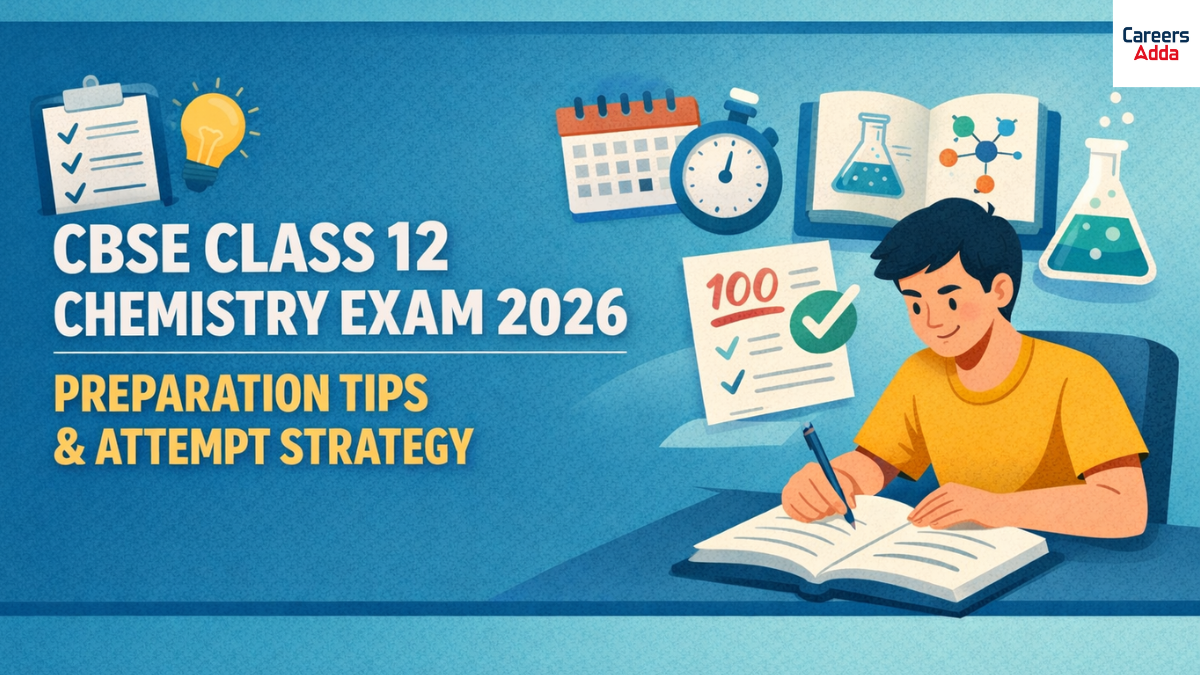
The Central Board of Secondary Education will conduct the Class 12 Chemistry exam on 28 February 2026. The board exams will be held in a single shift from 10.30 am to 1.30 pm. Chemistry subject paper is considered to be challenging as it includes topics from Physical, Organic and Inorganic Chemistry. The CBSE class 12 chemistry theory exam will be held for a total of 70 marks and will include multiple choice, short answer and long answer format. The Chemistry question paper will contain five sections from A to E as per the CBSE exam pattern. Scroll throughout the article to know all about the upcoming CBSE class 12th chemistry exams.

CBSE Class 12 Chemistry Exam Pattern
CBSE Class 12th Chemistry theory paper is divided into five sections (A–E). Sec A has 16 MCQs of 1 mark each, Sec B has 5 very short answer questions of 2 marks each, Sec C has 3 marks total 7 questions, Sec D has 2 case study based questions of 4 marks each and Sec E has 3 long questions of 5 marks each. Candidates must check the table listed below to know the complete Chemistry exam pattern in detail.
| CBSE Class 12th Chemistry Paper Pattern | |
| Instruction Aspect | Details |
| Exam Duration | 3 Hours |
| Maximum Marks | 100 Marks (Theory→ 70 marks & Practical→ 30 marks) |
| Reading Time | 15 minutes (10:15 AM to 10:30 AM) |
| Writing Time | Answers to be written only after 10:30 AM |
| Total Number of Questions | 33 questions |
| Totals Sections | 5 (Sec A, B, C, D and E) |
| Section A | Q1–16: MCQs, 1 mark each (16 × 1 = 16 marks) |
| Section B | Q17–21: Very short answer, 2 marks each |
| Section C | Q22–28: Short answer, 3 marks each |
| Section D | Q29–30: Case-based questions, 4 marks each |
| Section E | Q31–33: Long answer questions, 5 marks each |
| Internal Choice | Section B→E has internal choice |
| Calculators | Not permitted |
CBSE Class 12 Chemistry Marking Scheme
Candidates must understand that CBSE board has set different marking criteria for all the sections asked in the chemistry question paper. Marks allotted are different and stepwise marking is also given on numerical based problems. Candidates can go through the table to know section wise marking patterns to prepare better for the Class 12th Chemistry exam.
| CBSE Class 12 Chemistry Marks Distribution | ||||
| Section | Question Numbers | Question Type | Marks per Question | Total Marks |
| Section A | 1 – 16 | MCQs | 1 | 16 |
| Section B | 17 – 21 | Very Short Answer (VSA) | 2 | 10 |
| Section C | 22 – 28 | Short Answer (SA) | 3 | 21 |
| Section D | 29 – 30 | Long Answer (LA) | 4 | 8 |
| Section E | 31 – 33 | Case-based / Long Answer | 5 | 15 |
| Total | 33 Questions | — | — | 70 Marks |
Important Topics for CBSE Class 12 Chemistry
Class 12 CBSE Board students must focus on the important topics mentioned below so as to prepare effectively for the Chemistry exam and score high marks.
| Important Topics for CBSE Class 12 Chemistry | |
| Unit | Topics |
| Physical Chemistry | Solid State, Solutions, Electrochemistry, Chemical Kinetics, Surface Chemistry |
| Organic Chemistry | Alcohols, Phenols, Ethers, Aldehydes, Ketones, Carboxylic Acids, Amines, Biomolecules, Polymers, Chemistry in Everyday Life |
| Inorganic Chemistry | p-Block, d-Block, f-Block Elements, Coordination Compounds, Haloalkanes & Haloarenes, Periodic Table, Chemical Bonding |
| Practical Skills | Titration, Qualitative Analysis, Experiment Report, Viva |
Best Books CBSE Chemistry Class 12th
Class 12th CBSE students preparing for Chemistry exam should prepare using NCERT Chemistry Part I & II as per the board exam syllabus. Some additional books can also be referred for effective exam preparation such as Pradeep’s New Course Chemistry and Modern’s ABC of Chemistry. Students must also go through J.D. Lee for Inorganic Chemistry, P. Bahadur for Physical Chemistry numerical and Solomon & Fryhle for Organic Chemistry topics.
How to Prepare for CBSE Class 12 Chemistry Exam?
Candidates appearing for the upcoming CBSE Board Chemistry Class 12th exams must go through important points mentioned below and implement them in their daily routine to strengthen concepts, improve accuracy and score maximum marks in the final examination.
- Study NCERT line to line to highlight main points and focus on understanding concepts, reactions and mechanisms rather than memorizing them
- Solve Physical Chemistry numerical problems regularly to improve calculation speed and accuracy
- Attempt at least 5 years CBSE Class 12 Chemistry PYQs to understand paper patterns, marking scheme and difficulty level of the exam
- Maintain short notes for formulas, name reactions, mechanisms for quick revision
- Divide daily study time evenly among Physical, Organic and Inorganic Chemistry to maintain balance
- Attempt full length Chemistry mock tests using a timer to improve time management, accuracy and build confidence to handle the actual board exam pressure
CBSE Class 12th Chemistry Exam Attempt Strategy
CBSE Class 12 students must keep a plan ready to implement on the actual exam day so as to ensure all questions are solved within the allotted time.
- Start solving the easy questions first as to easily secure marks
- Show all steps while solving numerical problems as step wise marking is also given
- Don’t spend too much time on a single question skip it and come back later if time is left
- Theory answers must be written by clearly highlighting main points and key terms
- Avoid overwriting and write in neat handwriting so as to keep the answer sheet clean
- Review the numerical for correct calculations and equations for proper balancing
- Reserve the last 20 minutes only for review purpose so as to check and correct mistakes if done while solving answers
| Other Important Article for CBSE Class 12th | |
| CBSE Date Sheet | CBSE Admit Card |
| CBSE Class 12 Syllabus | CBSE Sample Papers |
| CBSE Class 12 PYQs | CBSE Class 12 English Sample Paper |

 CBSE Class 12 History Important Question...
 CUET Accountancy Preparation Plan 2026: ...
 CUET UG Accountancy Previous Year Questi...








 Call
Call 




