
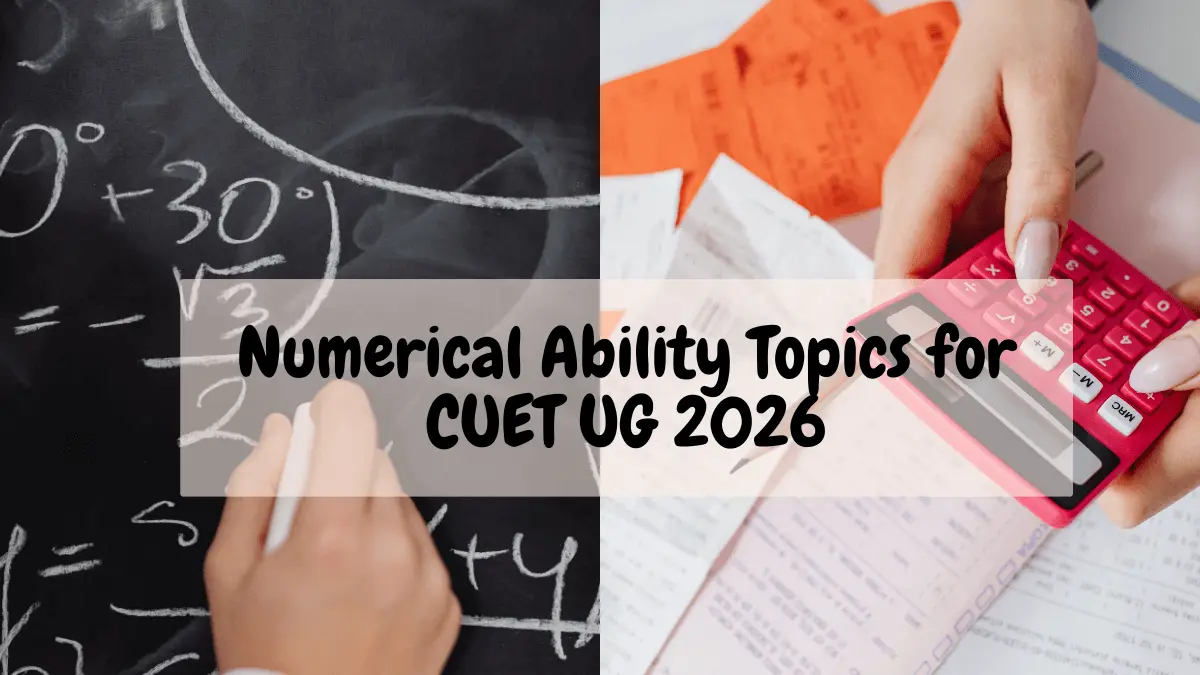
Numerical Ability in the CUET UG 2026 paper measures a candidate’s ability to use basic arithmetic ideas to answer numerical problems. Numerical Ability topics or chapters are mostly taught in the 12th class and class 10th syllabus. This section focuses on accuracy, speed, and fundamental clarity. This is where understanding the CUET numerical ability syllabus is critical for preparing for all of the included topics.
Numerical ability topics for CUET UG are included under the General Aptitude Test (GAT) section, but some domain-specific articles demand quantitative reasoning.
Numerical Ability Topics for CUET UG 2026
CUET UG 2026 Numerical Ability portion evaluates the student’s fundamental mathematical understanding, logical reasoning, and calculating speed. With the correct method and topic clarity, Numerical Ability topics for the CUET UG 2026 exam can become a high-scoring segment on the CUET exam. Candidates who choose the CUET General Test subject should review the main chapters for Numerical Ability in CUET UG.
How Many Questions are Asked in the CUET Numerical Ability Section?
According to CUET previous years’ papers and trends, around 25-30% of the CUET General Aptitude Test comprises numerical ability or quantitative aptitude problems.
Numerical Ability Topics for CUET UG 2026
The topics included in the CUET syllabus 2026 for the Numerical Ability section are given in the following 4 tables:
| Important Topics of Numerical Ability for CUET UG 2026 | ||
| Number System | Simplification and Approximation | Data Interpretation (DI) |
| Natural numbers, whole numbers, and integers | BODMAS rule | Tables |
| Rational and irrational numbers | Fractions and decimals | Bar graphs |
| Prime and composite numbers | Square roots and cube roots | Pie charts |
| Factors and multiples | Approximation techniques | Line graphs |
| HCF and LCM | ||
| Divisibility rules | ||
| Place value and face value | ||
| Important Topics of Numerical Ability for CUET UG 2026 | ||
| Percentage | Ratio and Proportion |
Profit, Loss and Discount
|
| Conversion between fraction, decimal, and percentage | Simple ratios |
Cost price (CP), selling price (SP)
|
| Percentage increase and decrease | Proportion and continued proportion |
Profit and loss percentage
|
| Successive percentage change | Division of quantities |
Discount and marked price
|
| Applications in real-life problems | Partnership problems |
Successive discounts
|
| Important Numerical Ability for CUET UG 2026 Topics | ||
| Simple Interest and Compound Interest | Time and Work | Time, Speed and Distance |
| Simple Interest (SI) formula | Work efficiency |
Speed, time, and distance relations
|
| Compound Interest (CI) | Combined work | Average speed |
| Difference between SI and CI | Time taken by individuals and groups | Trains, boats, and streams |
| Applications in banking scenarios | Pipes and cisterns (basic level) | Basic race problems |
| Important Chapters of Numerical Ability for CUET UG 2026 | |
| Averages | Mensuration (Basic) |
| Simple average |
Area and perimeter of a square, a rectangle, a triangle
|
| Weighted average |
Volume and surface area of cube and cuboid
|
| Average age problems |
Circle basics (area and circumference)
|
| Replacement method | |
Best Books for CUET 2026 Numerical Ability Topics
The CUET General Test has three subtopics: quantitative aptitude, logical reasoning, general knowledge, and current affairs. The best books to prepare for CUET Quants / Numerical Ability and Reasoning are listed below.
|
CUET 2026 Preparation Books for Numerical Ability
|
Author |
| Quantitative Aptitude for Competitive Examination | RS Agarwal |
| Shortcuts in Quantitative Aptitude for Competitive Exams | Disha Experts |
| Verbal & Non-Verbal Reasoning (FOR Reasoning section) | R.S. Aggarwal |
| Data interpretation | R.S. Aggarwal |
How to Score Better in Numerical Ability Topics for CUET 2026?
Follow the steps outlined here to accurately answer the questions in the Quantitative Aptitude or Numerical Ability test.
- Allocate your time wisely among various chapters, and don’t be afraid to skip a difficult one and return to it later.
- Make sure you understand what the question is asking.
- Determine the sort of problem (percentages, ratios, averages, etc.).
- Examine the answer to understand the steps performed and learn from any errors.
- Arrange the provided information in DI in a table or list.
- Select the appropriate formula for the question from the topic asked.
 CUET UG Previous Year Question Paper PDF...
 CBSE Class 12 Maths Exam Difficulty Leve...
 CBSE Class 12 Maths Paper Analysis 2026,...








 Call
Call 




