
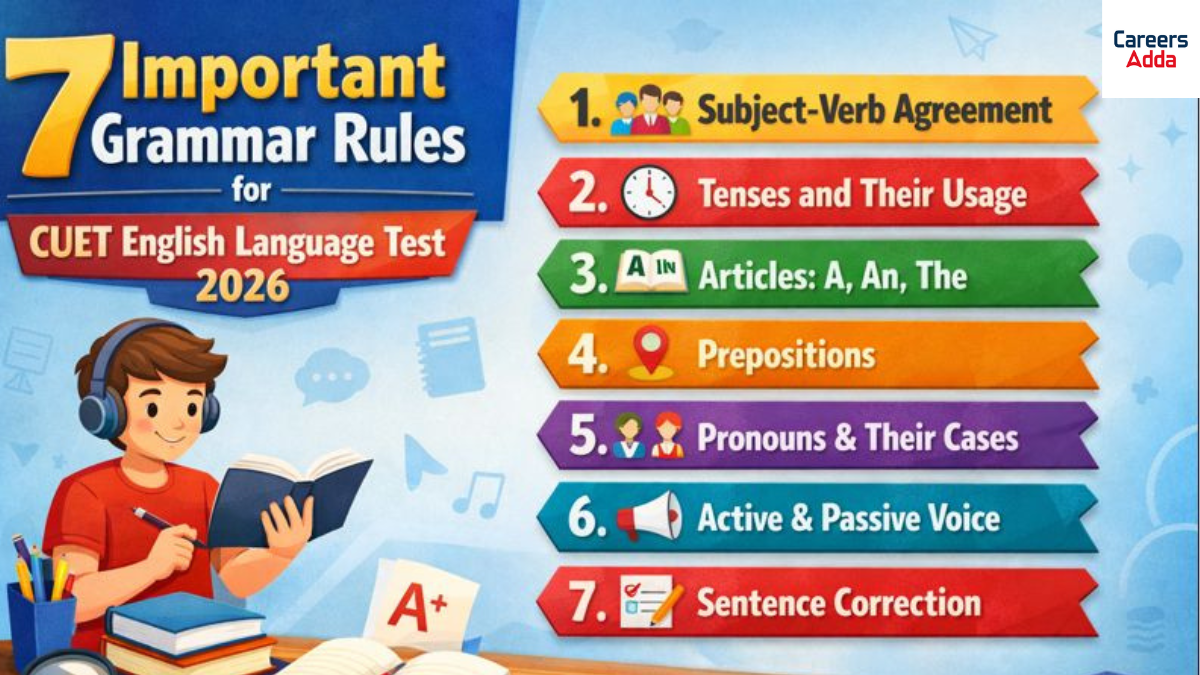
For those candidates preparing for CUET English grammar rules serve as the most scoring area of the language test. Questions from these topics are mostly direct and based on simple concepts as given in the books. With proper grammar knowledge and regular practicing of the rules candidates can easily attempt questions asked in the exam and clear the section. This article will help you understand the most important grammar rules for scoring good marks in the English section of CUET
Importance of English Grammar in CUET Language Test 2026
Grammar is the basic root of all the languages and plays an important role in the all the entrance exams. It helps students understand how sentences are formed and how words are used correctly. Most grammar questions in the entrance exams are direct and based on simple rules. A strong grammar base also improves reading and comprehension skills. With regular practice students can increase the accuracy of solving questions and score better marks without stressing too much.
List of Complete English Grammar Rule
Candidates can check the basic rules required for English grammar listed below.
- Parts of Speech
- Tenses and Their Usage
- Subject–Verb Agreement
- Articles (A, An, The)
- Active and Passive Voice
- Direct and Indirect Speech
- Prepositions and Conjunctions
Rule 1: Parts of Speech
Parts of speech are the basic units of English grammar. Every word in a sentence belongs to a part of speech, and knowing them helps in forming correct sentences and finding errors easily. Many CUET questions are based on wrong word usage.
Main Parts of Speech with Examples:
- Noun – name of a person, place, or thing
Example: doctor, school, book - Verb – shows action or state
Example: run, eat, is - Adjective – describes a noun
Example: happy child, red ball - Adverb – describes a verb
Example: runs fast, speaks clearly - Pronoun, Preposition, Conjunction
Example: he, in, and
Rule 2: Tenses and Their Usage
Tenses show the time when an action happens. CUET often asks questions based on correct tense usage in sentences and fill-in-the-blanks. Using the correct verb form is very important. Students should focus on verb forms and maintain the same tense in a sentence. Types of Tenses with Examples:
- Present Tense – action happening now
Example: She writes a letter. - Past Tense – action already completed
Example: She wrote a letter. - Future Tense – action yet to happen
Example: She will write a letter.
Rule 3: Subject–Verb Agreement
In English, the verb must agree with the subject in number and person. This rule is very common in CUET grammar questions and easy to score.
- Singular subject → singular verb
Example: He plays cricket. - Plural subject → plural verb
Example: They play cricket. - Words like each, everyone, nobody take singular verbs
Example: Everyone is ready.
Rule 4: Articles (A, An, The)
Articles are small words but play a big role in grammar. CUET often includes direct questions on article usage. Simple Rules with Examples:
- A – used before consonant sound
Example: a boy, a university - An – used before vowel sound
Example: an apple, an hour - The – used for specific nouns
Example: the sun, the book on the table
Rule 5: Active and Passive Voice
Voice shows whether the subject performs the action or receives it. Students should learn basic tense changes during conversion. In CUET language test questions are usually asked for sentence conversion between active and passive voice.
Example of Active and Passive Voice:
Active Voice: Ram wrote a letter.
Passive Voice: A letter was written by Ram
Rule 6: Direct and Indirect Speech
Direct and indirect speech are used to report what someone has said. In direct speech, the exact words of the speaker are written inside quotation marks. In indirect speech, the same idea is reported without using the speaker’s exact words. This rule is important because it helps in correct sentence reporting.When changing direct speech to indirect speech, the tense, pronouns, and time words often change.
Example:
- Direct Speech: She said, “I am preparing for the exam.”
- Indirect Speech: She said that she was preparing for the exam.
Rule 7: Prepositions and Conjunctions
Prepositions and conjunctions help in connecting words and showing relationships in a sentence. Prepositions show the relation between a noun or pronoun and another word. Example of Preposition – The book is on the table. Conjunctions are two or more words, phrases or sentences to make the meaning clear and show the relationship between ideas. Some words like and, but, or, for, so, yet, because, although, if, when, while are used for joining sentences. Example: She studied hard because she wanted to score well.
Example: I wanted to go, but it started raining.
 CUET PG LLB Exam Date 2026 OUT, Download...
 CUET PG 2026 Exam Dates (Out), Check Shi...
 CBSE 12th Political Science Important MC...





 Call
Call 




