
Important 5 Mark Questions for CBSE Class 12 Biology Exam 2026: Practising these 5 mark questions chapter-specific critical questions increases exam preparation and confidence in answering a variety of exam-level queries. Practice these sample questions and use them as a revision and learning tool for Class 12 Biology. The CBSE class 12 Biology paper asked 4 types of questions of 1 mark, 3 mark, 2 mark, 4 mark, and 5 mark. Some of the significant 5-mark biology questions for the CBSE class 12 board exam are included on this page.
Important 5 Mark Questions for CBSE Class 12 Biology Exam 2026
The important 5-mark questions for CBSE Class 12 Biology Exam 2026 are based on the latest CBSE curriculum and are drawn from various chapters of the CBSE syllabus. By answering these CBSE class 12 biology key questions, students can assess their CBSE board exam preparation 2026 and become familiar with a variety of problems.
Important Chapters from CBSE Class 12 Biology Exam 2026
Check out the most important chapters from the class 12 biology syllabus below:
| Important Topics | |
| Topic 1 | Mendel’s Law of Inheritance |
| Topic 2 | Sexual Reproduction in Flowering Plants |
| Topic 3 | Human Reproduction |
| Topic 4 | Biotechnology and Its Applications: |
| Topic 5 | Molecular Basis of Inheritance |
| Topic 6 | Origin of Life and Evolution |
| Topic 7 | Microbes in Human Welfare |
| Topic 8 | Human Health and Diseases |
| Topic 9 | Ecosystem |
| Topic 10 | Biodiversity and Conservation |
CBSE Class 12 Biology 5 Mark Questions
Below are a few crucial five-mark questions for the CBSE class 12 biology exam 2026 –
1. (i) Draw a schematic diagram of the cloning vector pBR 322 and label (1) Bam HI site (2) gene for ampicillin resistance (3) ‘ori’ (4) ‘rop’ gene.
(ii) State the role of ‘rop’ gene.
(iii) A cloning vector does not have a selectable marker. How will it affect the process of cloning ?
(iv) Why is insertional inactivation preferred over the use of selectable markers in cloning vectors ?
2. (i)With the help of labelled diagram only, show the different stages of embryo development in a dicot plant. (4 marks)
(ii) Endosperm development precedes embryo development. Justify.
3. (i) Name the nematode (scientific name) that infects the roots of tobacco plant and reduces its yield.
(ii) Name the vector that is used to introduce nematode-specific genes into the host plant (tobacco).
(iji) How do sense and anti-sense RNAs function ?
(iv) Why could parasite not survive in a transgenic tobacco plant ?
4. Draw a diagram of a human sperm. Label any four parts and write their functions. (4 marks)
In a human female, the probability of an ovum being fertilized by more than one sperm is impossible. Give a reason. (1 Mark)
5. (i) Why did Hershey and Chase use 35S’ and 32P’ in their experiment? Explain.
(ii) State the importance of (1) blending and (2) centrifugation in their experiment.
(iii) Write the conclusion they arrived at the end of their experiment.
Also, practice CBSE Biology Class 12 Sample Papers
6. Natural selection operates in different ways in nature.
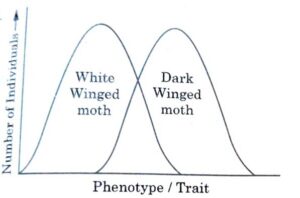
(i) Identify the type of natural selection depicted in the graph above.
(ii) In England, after industrialisation, the population of dark-winged moths was more favoured than white winged moths. Explain. experiment. (4 marks)
(ii) Anthropogenic action can enhance the rate of evolution. Explain with the help of an example.
7. Consider the following three possible diagnoses for infertility and answer the trailing questions.
(i) Inability to produce a normal egg.
(ii) Low Count of Sperm.
(iii) Blocked Fallopian tube
a) Suggest and explain different methods of ART based on clinical examination for the above cases.
b) What are the legally acceptable reasons that allow MTPs to be carried out?
8. The table below shows some of the 64 available codons and their associated amino acids.
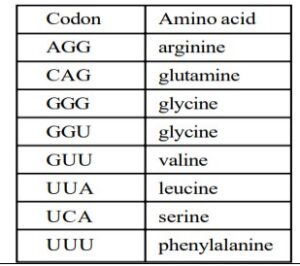
The diagram below shows the coding strand of a length of DNA with its bases indicated.
T A C A A T C C C A A A A TC
a) Write down the base sequence of a length of the mature RNA that would be transcribed from this DNA.
b) In a eukaryotic cell, the base sequence of the mRNA might be different from the sequence of the hnRNA. Explain why.
c) ‘Genetic code is nearly universal’. Explain this statement.
d) Explain why glycine has two codons in the above table.
e) Give reasons why RNA is less stable than DNA.
9. a) Innate immunity is a non-specific type of defense and consists of four types of barriers. Categorize these barriers and give one example for each.
b) Differentiate between benign and malignant tumors? Which one is lethal and why?
10. a) ABO blood group in humans is an example of multiple allelism and Codominance. Justify.
b) A couple who have blood groups A and B have four children. Each child has a different blood group. Explain with the help of crosses to show how this is possible.
11. a) State three characteristics of acquired immunity.
b) List the different ways by which it can be attained by humans.
Note – We will add more questions with answers. Until then, practice these concepts from the Biology NCERT books.




 CUET Result 2026 Out: Check Answer Key, ...
 How to Prepare for Law After Class 12 fo...
 CBSE Class 12 Accountancy Chapter 12 Not...






 Call
Call 




