
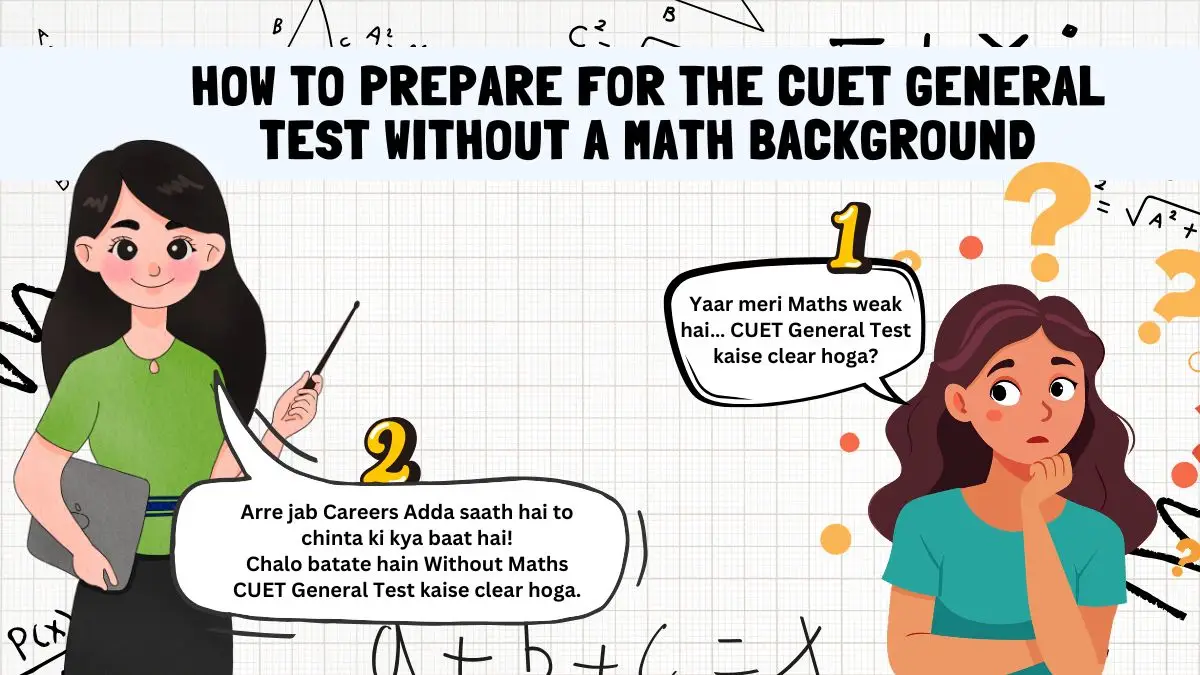
How to Prepare for the General Test Without a Math Background? For many students from Humanities, Arts, or Commerce (without Maths) streams, the phrase “General Test” in the CUET UG syllabus triggers a specific kind of anxiety. Specifically, students fear the Quantitative Reasoning section. If students haven’t touched a math textbook since the 10th grade, looking at syllabus terms like “Mensuration” or “Algebra” can feel overwhelming. They do not need to be a genius in Maths to ace the CUET General Test 2026. We have broken down how to bypass the math phobia, leverage strengths in General Knowledge and Logic, and tackle the quantitative section with smart strategies in this article.
How to Prepare for the General Test Without a Math Background?
The Common University Entrance Test (CUET 2026) Exam pattern is designed to be inclusive. The CUET General Test (Code 501) is designed to assess students’ overall aptitude, not their ability to solve complex calculus.
CUET General Test 2026 Overview
Check the overview of the GAT paper pattern below. The biggest advantage for non-math students is the choice. Students typically need to attempt 20 to 22 questions in Maths. This means if you encounter 5 to 8 extremely difficult math problems, you can simply skip them and still score full marks by focusing on GK, Current Affairs, and Logical Reasoning.
| Feature | Details |
| Total Questions | 60 Questions |
| Questions to Attempt | 50 Questions |
| Time Duration | 60 Minutes |
| Marking Scheme | +5 for correct answer,
-1 for incorrect answer |

GAT Syllabus Breakdown for CUET 2026
Many students make the mistake of thinking the General Test is just “Maths + GK”. In reality, the syllabus is broader and heavily favors students who are well-read and logical thinkers.
1. General Knowledge & Current Affairs (Easy)
This is where humanities and arts students often shine. The biggest advantage for non-math students is the choice. You typically need to attempt 50 out of 60 questions. This means if you encounter 5-8 extremely difficult math problems, you can simply skip them and still score full marks by focusing on GK, Current Affairs, and Logical Reasoning, so make this section strong. This section includes:
- Static GK: History, Geography, Polity, Science (basic inventions), Books & Authors, Awards.
- Current Affairs: National and international events, Sports, Politics, and major appointments from the last 6-12 months.
2. General Mental Ability & Logical Reasoning (Medium)
This section tests logic, not math. It involves:
- Analogies, Series (Letter/Number), Coding-Decoding.
- Blood Relations, Direction Sense, Ranking.
- Visual Reasoning (Patterns, Mirror Images).
3. Numerical Ability & Quantitative Reasoning (Hard)
This is the section that causes anxiety. However, the official syllabus clearly states the level is up to Grade 8 only. Topics include:
- Basic Arithmetic: Number System, HCF/LCM, Simplification.
- Commercial Maths: Percentage, Profit & Loss, Simple/Compound Interest.
- Mensuration (2D & 3D Area/Volume).
- Basic Algebra and Statistics (Averages, Ratios).
CUET GAT Preparation Strategy for Non-Math Students
Students cannot ignore the Quant section entirely, but they don’t need to master it like a JEE or IIT aspirant. Here is how a non-math student should approach it:
1. The “Grade 8” Mindset
Remind yourself that these are questions designed for 13-year-olds. They don’t require derivation; they require application. For example, instead of using long formulas for Compound Interest, learn the “successive percentage” method, which is intuitive.
2. Use Options to Solve Questions
Pro Tip: In many “Find the value of X” questions, you don’t need to solve the equation. Simply take the options (A, B, C, D) and plug them into the question to see which one fits. This is the “Reverse Engineering” method, and it is a lifesaver for non-math students.
3. Prioritize High-Yield, Low-Effort Topics
Some topics are easier to learn than others. Prioritize these:
- Easy: Number Series, Averages, Ratio & Proportion, Basic Simplification (BODMAS).
- Moderate: Profit & Loss, Simple Interest, Time & Work.
- Hard (Can be skipped if necessary): Geometry (if you struggle with visualization), Complex Mensuration, Advanced Algebra.
General Test Preparation Tips for Non-Math Backgrounds
Tips for non-maths background students to score higher in CUET 2026 general tests.
1. The “20-Minute Daily Math” Rule
Don’t binge-study math once a week. It causes burnout. Instead, commit to just 20 minutes of math practice every single day.
2. Have a Grip on Logical Reasoning
Since you are likely strong in language, you can master LR quickly. Topics like Coding-Decoding, Blood Relations, and Direction Sense should be your 100% accuracy zones. If you ace GK and LR, you take massive pressure off the Quantitative section.
3. Gamify Your Preparation
Sudoku, crossword puzzles, and mobile apps for “brain training” help improve mental agility without feeling like “studying.” This helps specifically with the General Mental Ability section.
4. Formula Sheets & Cheat Codes
Create a wall chart with essential formulas. Example: Area of Circle = πr², Speed = Distance/Time.
Look at this chart every morning. The goal is to memorize the 20-30 most common formulas, so you don’t blank out during the exam.
Time Management Strategies
The exam gives you roughly 1 minute per question. Speed is key.
1. The 3-Round Strategy:
Round 1 (0-20 mins):
- Go through the entire paper.
- Answer all GK and very easy Logic questions.
- These take 10-20 seconds each.
Round 2 (20-45 mins):
- Tackle the doable Math and Reasoning questions that require calculation, but you are confident about.
Round 3 (45-60 mins):
- Attempt the tricky ones or review your answers.
2. The “30-Second Rule”:
If you don’t understand how to start solving a question within 30 seconds, skip it. Do not let your ego keep you stuck on a math problem while easy GK questions are waiting at the end of the paper.
Practice GAT Mock Tests
You cannot learn to swim by reading a book about swimming. Similarly, you cannot pass the General Test just by reading formulas. You must practice.
Take at least one full-length mock test every week initially, increasing to two per week as the exam nears. Analyze your mocks:
- Did you skip the right questions?
- Did you lose time on a specific type of puzzle?
- Are you making calculation errors?
Analyzing errors is more important than the score itself.
General Test Study Materials for Non-Maths Students
Choosing the right CUET study resources is critical. You need books that explain concepts simply, not advanced guides for CAT or banking exams.
Top GAT Books
- General Knowledge: Lucent’s General Knowledge (Yellow Book) – The bible for static GK. For current affairs, rely on monthly digests like Pratiyogita Darpan or online compilations.
- Reasoning: A Modern Approach to Verbal & Non-Verbal Reasoning by R.S. Aggarwal.
- Quantitative Aptitude: Quantitative Aptitude for Competitive Examinations by R.S. Aggarwal. Alternatively, Fast Track Objective Arithmetic by Rajesh Verma is excellent for shortcuts.
- CUET Practice Books: Oswaal CUET Question Banks or Arihant’s General Test Guide are great for getting everything in one place.


 CUET UG History Preparation Strategy 202...
 Pratigya: Best CUET Commerce Crash Cours...
 MP Board 12th Result 2026 (Out Soon), Ch...








 Call
Call 




