
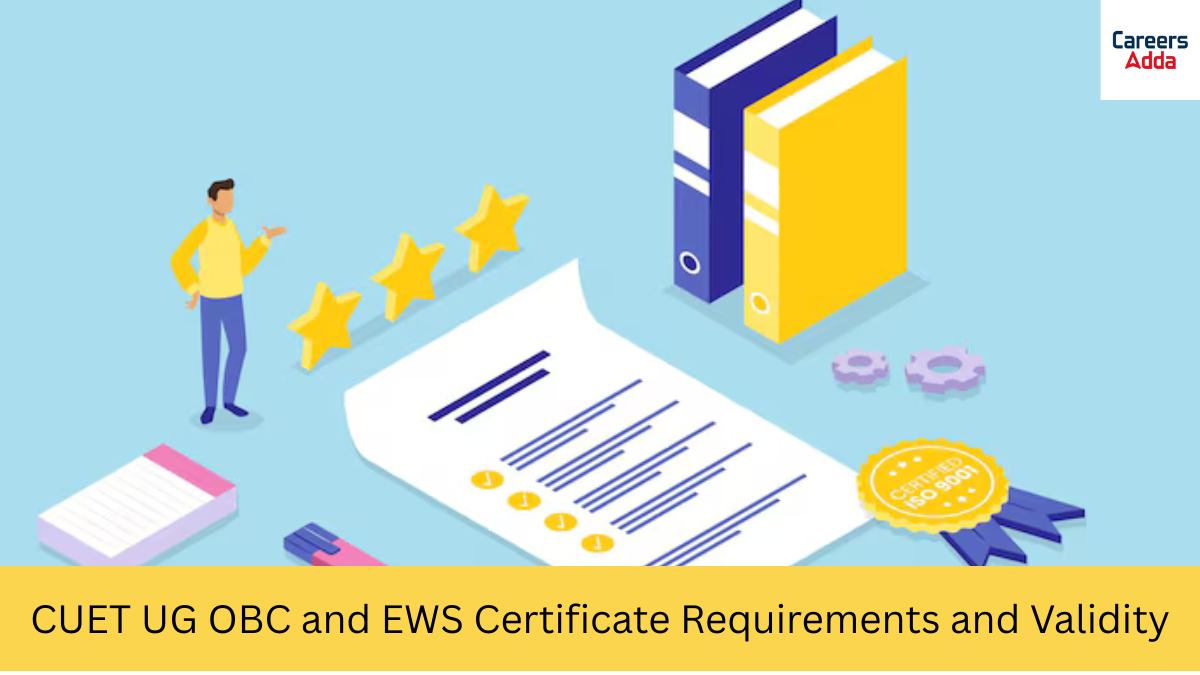
The Common University Entrance Exam is a national level entrance conducted by the NTA to offer admission to aspirants in various undergraduate courses in central, state and participating universities across India through a single window. It helps ensure fair and transparent admissions based on CUET merit list. Candidates applying under any reserved categories must meet the specific eligibility rules to claim certain benefits. Understanding the CUET UG OBC and EWS certificate requirements and validity is essential to avoid getting rejected during registration or counselling. This article helps to explain the OBC NCL certificate rules, EWS certificate validity, and important NTA guidelines for CUET UG category certificates that candidates need to know for the exam.
Download CUET Study Materials 2026 for Free

OBC Certificate Requirements for CUET UG
Candidates applying under the OBC-NCL category for the CUET UG entrance must belong to a certain OBC community recognized by the Central Government. The OBC certificate must be issued in the prescribed Central Government format and must clearly mention the “Non-Creamy Layer” status. The income criteria should comply with the latest guidelines of NCL issued by the government. State specific or outdated certificates will not be accepted under any circumstances.
Validity of OBC Certificate for CUET UG Exam
For CUET UG entrance the OBC NCL certificate must be issued as per Central Government rules and should be valid at the time of CUET counselling and admission. In most cases the certificate is required to be issued after March 31 of the previous financial year. The candidates must confirm the exact date from the CUET official information bulletin. The certificate must clearly mention Non-Creamy Layer (NCL) status and the caste should be listed in the Central OBC list available on the official NCBC website. Certificates based only on state OBC list or those that are expired are not accepted by any institute and such candidates may be considered under the General category. To avoid any issues at the admission stage candidates are advised to keep a recent and valid OBC-NCL original certificate ready to claim reservation benefits in CUET UG.
EWS Certificate Requirements for CUET UG
CUET UG aspirants applying under the EWS category must meet the income rules set by the Government of India. The total income of the family should be less than ₹8 lakh which includes all income sources. Along with income criteria candidates must also satisfy asset limits which means that the family should not own 5 acres or more of agricultural land, large residential flats, or oversized residential plots. The EWS certificate must be issued as per the latest prescribed format by a Tehsildar or District Magistrate and should clearly mention the family income and asset details in the certificate. Any handwritten, overwriting or unclear information on the EWS certificate may lead to disqualification during the verification process.
Validity of EWS Certificate for CUET UG Exam
All the CUET exam aspirants must note that the EWS certificate must be valid as per the guidelines issued by the Government of India. Candidates should ensure that the certificate is issued for the current financial year and remains valid at the time of CUET UG admission and counselling. As expired or outdated EWS certificates will not be accepted and in such cases the candidate will be treated only under the General category. To avoid any issues in the future during document verification all EWS eligible candidates are advised to obtain a fresh EWS certificate in the prescribed format before the admission process starts.
Format for OBC NCL and EWS Certificates
The EWS and OBC NCL certificates must be strictly issued in the prescribed format by the Central Government to be accepted for CUET UG and other central admissions. Both certificates should clearly mention things like- basic applicant’s details such as name, father’s name, address and relevant category information. In the OBC NCL certificate there should be a clear declaration that the candidate belongs to a particular backward class and does not fall under the creamy layer as per the central government rules. Similarly the EWS certificate should clearly mention that the total family income is within the prescribed limit and that the candidate meets the required asset conditions along with confirmation that they do not belong to SC, ST, or OBC categories. The government issued certificate must also carry official references along with the seal and signature as per government guidelines. Candidates are advised to use only the formats given by central government or university admission portals, as any deviation from the prescribed format may lead to rejection during document verification.
Important NTA Guidelines for OBC & EWS Certificates
Candidates falling under the reserved category must ensure that their OBC NCL or EWS certificate is issued on or after 1 April 2026 as the National Testing Agency (NTA) requires a fresh document for each financial year to verify the current income status. For OBC candidates the specific caste must be listed in the Central List of the NCBC (State lists alone are not sufficient) and the certificate must confirm their Non-Creamy Layer status. If candidates don’t have any updated certificate by the application deadline. They can upload a self-declaration/undertaking (available in the official NTA bulletin) as a temporary measure provided during the university counseling process of CUET UG.
| Also Read | |
| LSR College Admission 2026 | Miranda House Admission 2026 |
| CUET Syllabus 2026 | CUET Cut Off 2026 |
| CUET Exam Pattern 2026 | CUET Previous Year Question Paper |
| CUET Colleges | CUET UG Preparation Tips |

 MH CET Law 2026 Last Date Syllabus, Exam...
 CUET Accountancy Syllabus 2026 OUT, Down...
 CBSE Class 12 Sanskrit Question Paper 20...






 Call
Call 




