
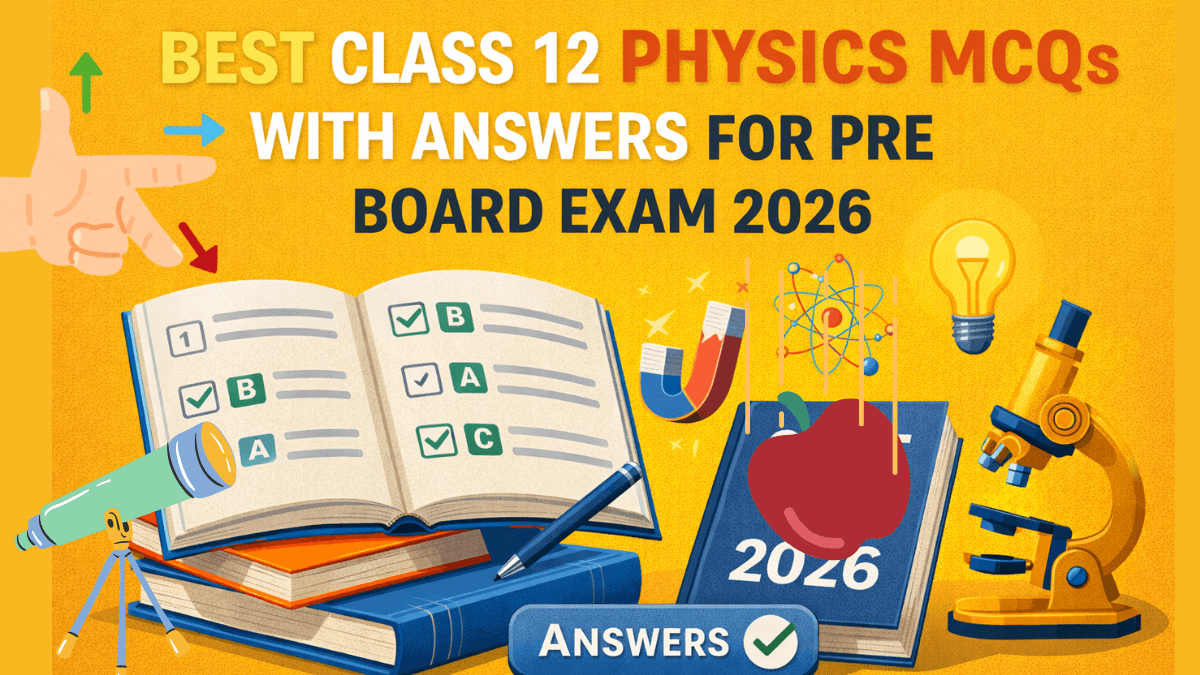
Practising Class 12 Physics MCQs will help students understand the concepts in more depth for the upcoming 2026 Pre Board Exams. Best Multiple Choice Questions in Physics involve questions about numerical concepts, formulas, and derivation calculations. Physics MCQs cover all 15 chapters and units in the CBSE Physics Syllabus for Class12. Class 12 Physics MCQs cover vital topics such as current optics, electricity, alternating current, electromagnetic waves, and so on. The top Physics Class 12 MCQs are listed from important chapters below.
Best Class 12 Physics MCQs with Answers for Pre Board Exam 2026
Check the 15 multiple-choice questions for the 12th Class Physics syllabus from important chapters.
Download Physics Class 12 Study Materials 2026 for Last Minute Revision
Top Physics MCQs with Answers for Board Exam 2026 Class 12
Each MCQ will have four options, only one of which is correct. Students must select the correct option and verify the solution provided here.
Important Class 12 Physics MCQs
1. The work done in bringing a unit positive charge from an infinite distance to a point at distance x from a positive charge Q is W. Then the potential at that point is
(a)WQ/x
(b) W
(c) W/x
(d) WQ
Answer: b
2. Consider a uniform electric field in the z-direction. The potential is a constant
(a) for any x for a given z
(b) for any y for a given z
(c) on the x-y plane for a given z
(d) all of these
Answer: d
3. Which of the following is not a property of electric field lines?
(A) Field lines are closed and continuous curves without any breaks
(B) Two field lines cannot cross each other.
(C) Field lines start at positive charges and end at negative charges.
(D) They do not form closed loops.
Answer: A
4. Electric flux emanating through a surface element dS = 10î placed in an electric field E = 2î + 3j + 4kis
(A) 10 units
(B) 20 units
(C) 4 units
(D) 16 units
Answer: B
5. Cathode rays travelling from west to east enter the region of the electric field directed towards south to north in the plane of the paper. The deflection of cathode rays is towards:
(A) East
(B) West
(C) North
(D) South
Answer: D
6. A particle of charge e and mass m moves with a velocity v in a magnetic field B applied perpendicular to the motion of the particle. The radius r of its path in the field is
a. mv/Be
b. Be/mv
c. ev/Bm
d. Bv/em
Answer: A
7. Magnetic lines of force due to a bar magnet do not intersect because
a) A point always has a single net magnetic field
b) the lines have similar charges and so repel each other
c) the lines always diverge from a single force
d) the lines need magnetic lenses to be made to interest
Answer: A
8. Which of the following phenomena of light results in a mirage?
a. Refraction of light
b. Reflection of light
c. Total internal reflection
d. Diffraction of light
Answer: C
9. For a total internal reflection, which of the following is correct?
(a) Light travels from a rarer to a denser medium.
(b) Light travels from a denser to a rarer medium.
(c) Light travels in air only.
(d) Light travels in water only.
Answer: b
10. An astronomical refractive telescope has an objective of focal length 20 m and an eyepiece of focal length 2 cm. Then
(a) The magnification is 1000
(b) The length of the telescope tube is 20.02 m
(c) The image formed of inverted
(d) all of these
Answer: d
11. Two lenses of focal lengths 20 cm and – 40 cm are held in contact. The image of an object at infinity will be formed by the combination at
(a) 10 cm
(b) 20 cm
(c) 40 cm
(d) infinity
Answer: c
12. Which of the following has the minimum wavelength?
(a) Blue light
(b) γ-rays
(c) infrared rays
(d) microwave
Answer: (b) γ-rays, this have the maximum frequency, so the minimum wavelength among electromagnetic waves.
13. Which of the following has the maximum penetrating power?
(a) Ultraviolet radiation
(b) Microwaves
(c) γ-rays
(d) Radio waves
Answer: (c) γ-rays have the maximum frequency and energy of a proton; therefore, maximum penetrating power.
14. Equipotentials at a great distance from a collection of charges whose total sum is not zero are approximately.
(a) spheres
(b) planes
(c) paraboloids
(d) ellipsoids
Answer: a
15. The electric potential V at any point O (x, y, z, all in metres) in space is given by V = 4x² volts. The electric field at the point (1 m, 0, 2 m) in volt/metre is
(a) 8 along the negative x-axis
(b) 8 along the positive x-axis
(c) 16 along the negative x-axis
(d) 16 along the positive z-axis
Answer: a
 CBSE Class 10 Social Science Question Pa...
 CUET PG Admit Card 2026 Out, डाउà¤...
 MHT CET 2026 Correction Window (Live), E...









 Call
Call 




