
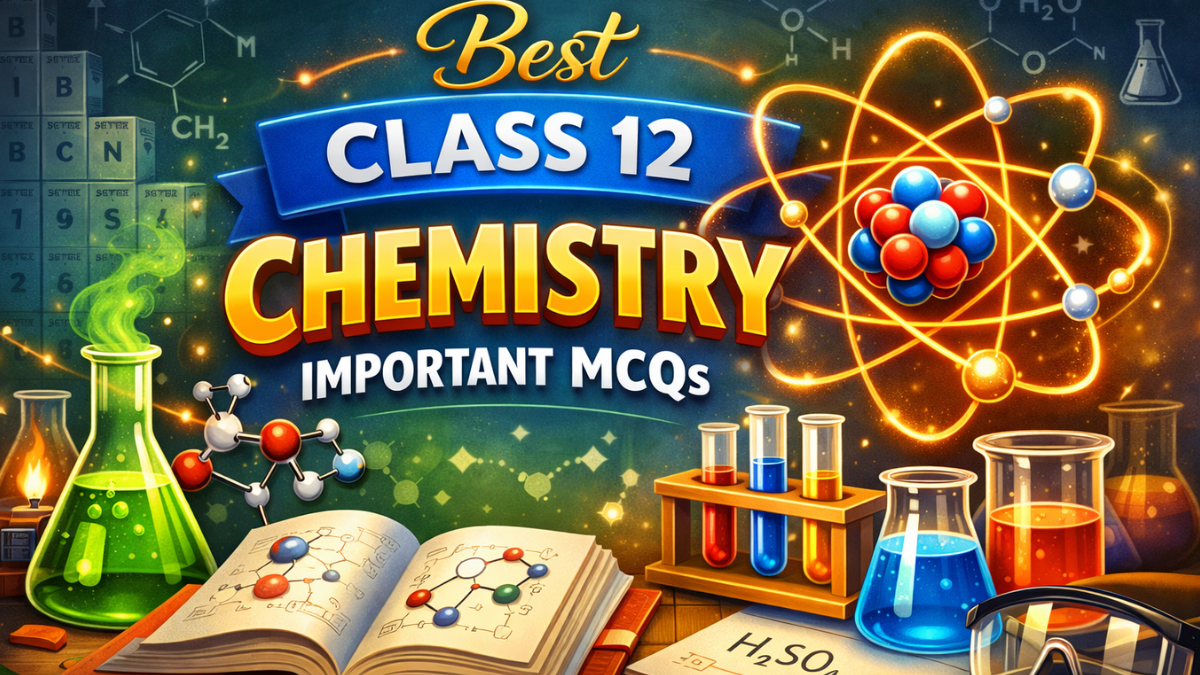
The best Class 12 Chemistry Important MCQs Questions with Answers are produced by experts in accordance with the latest CBSE Board 2026 curriculum, NCERT books, and exam pattern for Class 12. We have provided the most important MCQ Questions for Class 12 Chemistry for high-weightage chapters to help students understand the paper level and the question pattern. To boost exam preparation, students should also practice CBSE Class 12 Sample Papers, which provide real exam insight and improve time management.
Best Class 12 Chemistry MCQs for Boards 2026
Our academic specialists have developed the best Class 12 Chemistry MCQs for the upcoming board examination with answers. MCQ Questions for Class 12 provide you with confidence in answering the questions on the exam. If practised properly, it can help you get higher scores. Using these crucial chemistry chapter-wise questions helps students gain confidence as they study. They can practice answering most expected chemistry MCQ questions.
Also Check:
- Class 12 Biology Important MCQs with Answers for Upcoming Exams
- Class 12 Physics Important MCQs with Answers for Upcoming Exams
Class 12 Chemistry Chapter-wise Weightage
Based on the previous year’s question papers, we have shared complete details of the Chemistry Class 12 CBSE Chapter-wise Weightage in the table. CBSE Class 12 Chemistry Chapter Wise Weightage aware students how marks are divided across chapters. Knowing the weightage helps students focus on relevant areas and prepare efficiently for the board test.
| Chemistry Class 12 CBSE Chapter-wise Weightage | |
| Unit/Chapter | Marks |
| Solutions | 7 |
|
Electrochemistry
|
9 |
|
Chemical Kinetics
|
7 |
|
d- and f-Block Elements
|
7 |
|
Coordination Compounds
|
7 |
|
Haloalkanes and Haloarenes
|
6 |
|
Alcohols, Phenols and Ethers
|
6 |
|
Aldehydes, Ketones and Carboxylic Acids
|
8 |
| Amines | 6 |
| Biomolecules | 7 |
| Total | 70 |
Class 12 Chemistry Top 100 Most Expected Questions
Refer to the video and practice about the Top 100 most expected questions with proper answers explanation. These questions are based on the trends as asked in the previous year’s question papers.
Important Class 12 Chemistry MCQs with Answers Chapter Wise
Practice the following MCQ Questions with answers and explanation for Class 12 Chemistry with Answers.
Q. Temperature-dependent term among the following is –
(a) Molality
(b) Molarity
(c) Mole fraction
(d) Weight percentage
Answer: (b) Molarity
Q. Which of the following statements about maltose is incorrect?
a) It consists of two glucopyranose units
b) It is a disaccharide
c) Glycosidic bond between C1 of one unit and C4 of the other unit
d) It is a non-reducing sugar
Answer: d) It is a non-reducing sugar
Q. Which reagent is used to convert glucose into saccharic acid?
(a) Br2 / H2O
(b) Nitric acid
(c) Alkaline solution of iodine
(d) Ammonium hydroxide
Answer : (b) Nitric acid
Explanation: Nitric acid is a strong oxidising agent. It can oxidise the alcohol and the aldehyde. Thus, in glucose, the C-1 and C-6 have the aldehyde and the primary alcohol to oxidise into carboxylic acid, forming the saccharic acid compound.
Q. Which of the following monosaccharides is a pentose?
(a) Glucose
(b) Fructose
(c) Arabinose
(d) Galactose
Answer : (c) Arabinose Explanation: Arabinose is a pentose monosaccharide, while glucose, fructose and galactose are hexose sugars.
Q. Isotonic solutions have the same-
(a) Vapour pressure
(b) Freezing temperature
(c) Osmotic pressure
(d) Boiling temperature
Answer: (c) Osmotic pressure
Q. Which of the following statements about starch is incorrect?
a) gives a blue colour with iodine
b) It is a polymer of a-D-glucose
c) Its a reducing carbohydrate
d) lconsists of branched chains
Q. How much electricity, in terms of Faraday, is required to produce 100 g of Ca from molten CaCl2?
(a) 1F
(b) 2F
(c) 3F
(d) 5F
Answer: (d) 5F
Q. The standard reduction potential at 298K for the following half cells is given: Which is the strongest reducing agent?
(a) Zn(s)
(b) Cr(s)
(c) Both
(d) None of these
Answer: (a) Zn(s)
Q. Standard electrode potential of three metals X, Y and Z are – 1.2 V, + 0.5 V and – 3.0 V, respectively. The reducing power of these metals will be :
(a) Y > Z > X
(b) X > Y > Z
(c) Z > X > Y
(d) X > Y > Z
Answer : (d) X > Y > Z Explanation: The higher the reduction potential lesser the reducing power and vice-versa. Hence, the order of reducing power is Z > X > Y.
Q. The rate constant of a reaction depends upon
(a) temperature of the reaction
(b) extent of the reaction
(c) initial concentration of the reactants
(d) the time of completion of the reaction
Answer : (a) temperature of the reaction
Explanation: The rate constant of a reaction depends on its temperature only and is not affected by concentration
Q. The role of a catalyst is to change
(a) Gibbs energy of reaction
(b) enthalpy of reaction
(c) activation energy of the reaction
(d) equilibrium constant
Answer : (c) activation energy of the reaction
Explanation: The role of a catalyst is to change the activation energy of the reaction. This is done by either increasing or decreasing the activation energy of the molecule, as catalysts are mainly of two types: + ve catalyst and (-ve) catalyst.
Q. The order of reaction can be
(a) 0
(b) fraction
(c) whole number
(d) integer, fraction, zero
Answer : (d) integer, fraction, zero
Explanation: Order of reaction is equal to the no of molecules whose concentration is changing with time. It can be zero or in fractions or an integer.
Q. The negative part of the addendum (the molecule to be added) adds on the carbon atom of the double bond containing the least number of hydrogen atoms. This rule is known as
(a) Saytzeffs rule
(b) Peroxide rule
(c) Markovnikov’s rule
(d) Van’t hoff rule
Answer : (c) Markovnikov’s rule
Explanation: According to the Markovnikov rule, the negative part of the unsymmetrical reagent adds to the less-hydrogenated ( more substituted) carbon atom of the double bond. So here the negative part of the addendum gets attached to that carbon which possess lesser number of hydrogen atoms.
Q. Grignard reagents are formed by the reaction of alkyl halides with warming
(a) with an alcoholic solution
(b) with MgCl2
(c) Mg in the presence of dry ether
(d) with MgCO3
Answer : (c) Mg in the presence of dry ether
Explanation: Grignard reagents are formed by the reaction of alkyl halides with Mg, warming Mg in the presence of diethyl ether.
Q. Which alkyl halide has the maximum density?
(a) C3H7I
(b) C2H5I
(c) CH3I
(d) CH3Br
Answer : (c) CH3I Explanation: The alkyl halide that has the highest density is methyl iodide (CH3I). Due to the lowest carbon content inCH3I and a heavy halogen atom.
How to prepare for the CBSE Class 12 Chemistry Exam?
The CBSE Class 12 Board exams are around the corner. As per the given timetable, the exams will be started form february 17, 2026. To do well in the Chemistry exam, you should focus on revising the concepts you have learnt ealier before. In these final days, students should focus to improve your concepetual undersatnding and practice the MCQs and other types of questions to get familiar with the real exam-like environment. You may join the Class 12 Science Crash course to excel in your preparation.
 CBSE Class 10 Social Science Question Pa...
 CUET PG Admit Card 2026 Out, डाउà¤...
 MHT CET 2026 Correction Window (Live), E...







 Call
Call 




