
CBSE Class 12 Accountancy Chapter 11 notes are aligned with the newest CUET 2026 Accountancy syllabus. All the Accounts notes are written in plain, unambiguous language available in English. The Accountancy Chapter 11 Class 12 Notes are ideal for last-minute revisions to improve exam confidence and performance. Don’t pass up this useful CUET study material if you want to improve your score on your forthcoming CUET UG accounting exam.
CBSE Class 12 Accountancy Chapter 11 Notes
Accountancy is the study of financial transactions, including recording and reporting. Our CBSE Class 12 Accountancy Chapter 11 Notes PDF focuses on financial reporting, accounting concepts and methods, taxation, corporate law, auditing, and cost accounting. Chapter 11 Accounts Notes also emphasizes the examination of economic performance and the application of financial models to decision-making. Class 12 accountancy is intended to prepare students for future study in the fields of accounting and finance.

Download CUET Accountancy Chapter 11 Notes PDF for Quick Revision
CUET Accountancy Chapter 11 Notes PDF can help you prepare for the CUET 2026 and revise the chapters. Our Careers Adda Commerce Domain educators attentively created these outstanding notes. Download the CUET Accountancy Chapter 11 Notes PDF for a quick revision.
Check our best Careers Adda CUET Commerce crash courses for Accounts students, to complete the syllabus from our expert faculty.
Accountancy Notes for Chapter 11 – Ratio Analysis
Check the highlights of the CUET Accountancy Chapter 11 Notes here, and download the PDF for full notes.
Meaning of Ratio Analysis
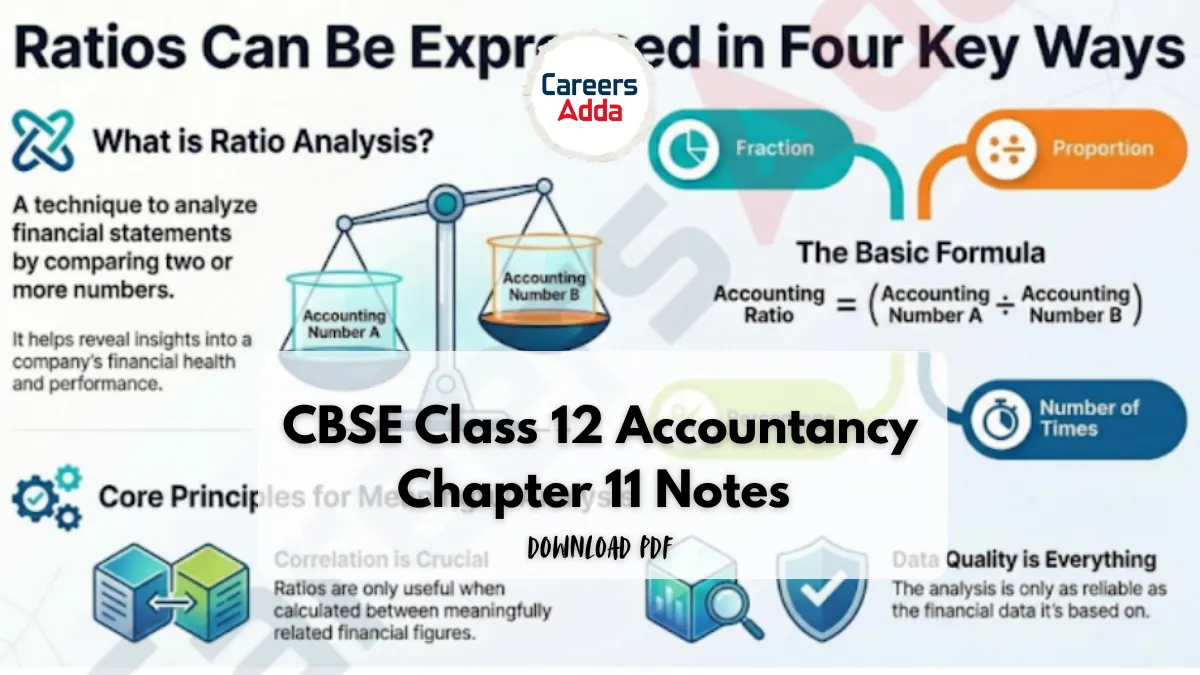
Ratio analysis is a technique of financial statement analysis that involves the mathematical calculation of relationships between two or more accounting numbers derived from financial statements.
• Relationship Expression: A ratio can be expressed as a fraction, proportion, percentage, or a number of times.
• Meaningful Correlation: To be useful, ratios must be calculated using numbers that are meaningfully correlated; unrelated figures result in meaningless data.
• Dependence on Data: The efficacy of a ratio depends on the basic numbers; if financial statements contain errors, the derived ratio will be erroneous.
• Formula of Ratios:
o Accounting Ratio = (Accounting Number A ÷ Accounting Number B).
o Percentage Expression = (Numerator ÷ Denominator) × 100.
Objectives of Ratio Analysis
Ratio analysis serves as an indispensable part of interpreting financial results by regrouping data through arithmetical relationships. Its primary objectives include:
• Highlighting Attention Areas: To identify specific sections of the business that require more management attention.
• Identifying Improvement Potential: To locate potential areas where performance can be enhanced with targeted effort.
• In-depth Evaluation: To provide a deeper analysis of the firm’s levels of profitability, liquidity, solvency, and efficiency.
• Cross-sectional Analysis: To compare firm performance against the best available industry standards.
• Projections: To provide information useful for making estimates and projections for the future.
Advantages of Ratio Analysis
Properly conducted ratio analysis improves the user’s understanding of business efficiency and sheds light on latent aspects of
the business.
• Decision Efficacy: It helps users understand if the firm has made the right operating, investing, and financing decisions.
• Simplification: It simplifies complex accounting figures and effectively summarizes financial information to assess creditworthiness and earning capacity.
• Comparative Analysis: By keeping multiple years of figures side-by-side, it helps explore visible trends and make projections.
• Problem Identification: It acts as a “whistleblower” by identifying problem areas (weak spots) and bright spots.
• SWOT Analysis: It helps management understand current threats and opportunities, enabling a formal Strength-Weakness- Opportunity-Threat analysis.
• Benchmarking: It allows for various comparisons:
o Intra-firm: Comparison over different accounting periods within the same firm.
o Inter-firm: Comparison with other business enterprises.
o Industry Standards: Comparison against set industry expectations.
Limitations of Ratio Analysis
Since ratios are derived from financial statements, any weakness in the original data reflects in the analysis.
1. Limitations Arising from Financial Statements
• Accounting Data Precision: Accounting data reflects opinions and personal judgments of accountants rather than absolute facts.
• Price-level Changes: It ignores inflation; a change in the price level makes the analysis of different years meaningless because historical records ignore the decline in the power of money.
• Qualitative Factors: Analysis is limited to quantitative (monetary) aspects and completely ignores non-monetary or qualitative factors.
• Variations in Policies: Differing policies for inventory valuation or depreciation between firms make valid inter-firm comparisons difficult.
2. Specific Limitations of Ratios
• Means, Not End: Ratios are merely tools for analysis; they are a means to an end rather than the end itself.
• No Resolution: Ratios are indicative only; they point out problems but do not provide solutions.
• Lack of Standards: There are no standardized definitions for many concepts (e.g., liquid liabilities) and no universally accepted “ideal” ratio levels in many industries.
• Historical Nature: Forecasting based solely on historical analysis is often not feasible without considering non-financial factors.
• Unrelated Figures: Some Ratios are calculated from unrelated figures (e.g., Creditors ÷ Furniture) that are irrelevant for assessing efficiency.
Types of Ratios
1. Liquidity Ratios: To meet its commitments, business needs liquid funds. The ability of the business to pay the amount due to stakeholders as and when it is due is known as liquidity, and the ratios calculated to measure it are known as ‘Liquidity Ratios’. These are essentially short-term in nature.
2. Solvency Ratios: Solvency of business is determined by its ability to meet its contractual obligations towards stakeholders, particularly towards external stakeholders, and the ratios calculated to measure solvency position are known as ‘Solvency Ratios’. These are essentially long-term in nature.
3. Activity (or Turnover) Ratios: This refers to the ratios that are calculated for measuring the efficiency of operations of business based on effective utilisation of resources. Hence, these are also known as ‘Efficiency Ratios’.
4. Profitability Ratios: It refers to the analysis of profits in relation to revenue from operations or funds (or assets) employed in the business and the ratios calculated to meet this objective are known as ‘Profitability Ratios’.
Get the Full Accountancy Notes for Chapter 11 from the PDF






 How to Prepare for Law After Class 12 fo...
 CBSE Class 12 Accountancy Chapter 12 Not...










 Call
Call 




