
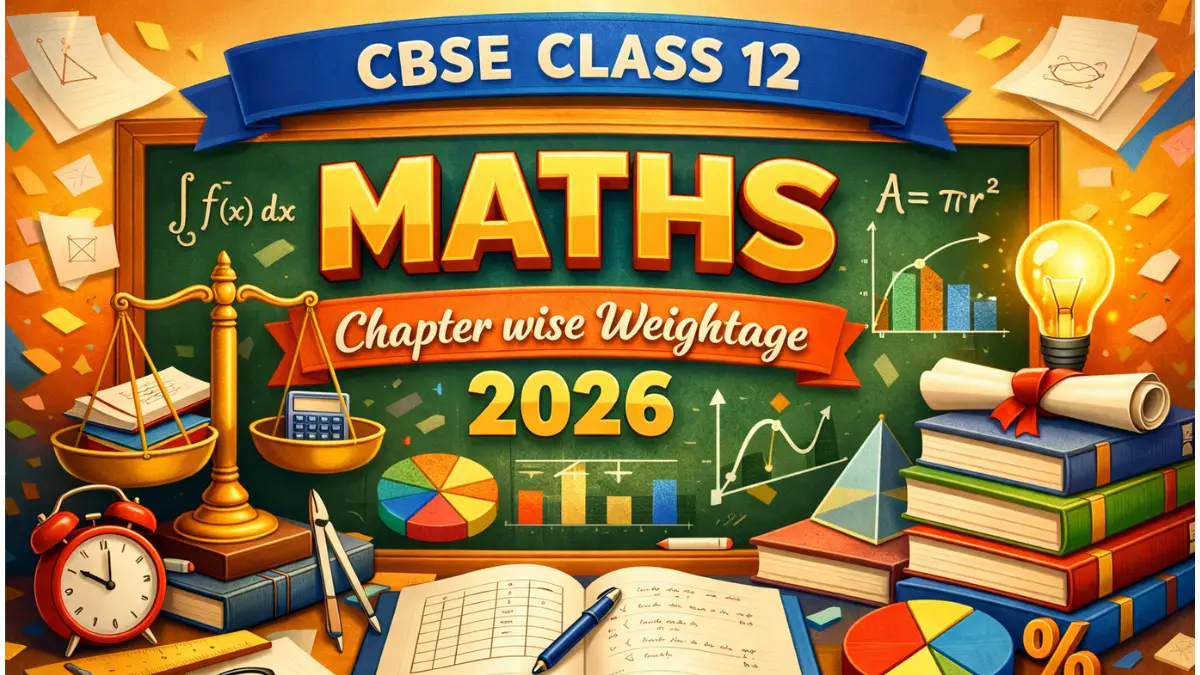
The Central Board of Secondary Education is scheduled to conduct the Mathematics basic and standard courses on 17 February 2026. All the students from a science or commerce background who opt out of mathematics have now shifted their focus to practising rather than learning new concepts. CBSE Class 12 Maths Chapter-wise Weightage 2026 helps students understand the marks distribution across different chapters in the board exam. By implementing such an effective study strategy, you can increase your chances to get succeed in the class 12 mathematics examination.
CBSE Class 12 Maths Chapter wise Weightage 2026
Knowing the Class 12 Maths chapter wise weightage allows students to better plan their study schedule by focusing on areas with more marks. Calculus, algebra, vectors, linear programming, and probability are among the important topics tested in the Class 12 Maths exam. It enables them to prioritise essential chapters in order to achieve the highest possible board exam result. Check CBSE Maths Chapter Wise Weightage 2026 for Class 12 students given in the table below
| CBSE Maths Chapter Wise Weightage Class 12 | ||
| Unit No. | Unit Name | Marks |
| I | Relations and Functions | 8 |
| II | Algebra | 10 |
| III | Calculus | 35 |
| IV | Vectors and Three-Dimensional Geometry | 14 |
| V | Linear Programming | 5 |
| VI | Probability | 8 |
| Total | — | 80 |
-
- Must Check: CBSE Class 12th Physics Chapter-Wise Weightage
CBSE Class 12 Mathematics 2026 Exam Pattern and Marking Scheme
CBSE Class 12 Maths test will be held offline for a total of three hours; however, a window of 15 minutes is provided to read the question paper only. The Maths theoretical paper will be worth 80 points, while the internal assessment will be worth 20 points and will include activities, projects, and so on. The CBSE Class 12 Maths Question paper includes different types of questions such as MCQs, SAQs and LAQs. Here is the question type-wise maths paper pattern, which emphasises the class 12 maths grading scheme:
| CBSE Class 12 Maths 2026 Exam Pattern and Marking Scheme | ||||
| Section | Type of Questions | Marks per Question | Number of Questions | Total Marks |
| Section A | Very Short Answer | 1 mark | 6 | 6 |
| Section B | Short Answer | 2 marks | 6 | 12 |
| Section C | Long Answer I | 3 marks | 10 | 30 |
| Section D | Long Answer II | 5 marks | 6 | 30 |
| Total | 28 | 80 | ||
CBSE Class 12 Maths Unit wise Weightage: Key Topics
On the basis of the previous year’s question paper analysis, we have shared a complete list of key topics where frequently questions are asked in the examination.
| Unit Name |
Important Topics
|
| Relations and Functions |
Types of relations, types of functions, inverse trigonometric functions.
|
| Algebra |
Matrix, determinant and its usages.
|
| Calculus |
Continuity, differentiability, applications of derivatives, integrals, and differential equations.
|
| Vectors and Three-Dimensional Geometry |
Vector algebra, scalar, and vector products and equations of lines and planes.
|
| Linear Programming |
Formulations of linear programming problems and the graphical method of solutions.
|
| Probability |
Conditional probability, Bayes’ theorem, and probability distributions.
|
One Shot Revision Video for Class 12 Maths
To help students, we conducted a session where the faculty provide complete revision of the key topics in one go.
How to Prepare for CBSE Class 12 Mathematics 2026?
Preparing for CBSE Class 12 Maths 2026 necessitates a targeted strategy, solid conceptual clarity, and frequent practice. Students should prioritise mastering NCERT basics, completing PYQs, and reviewing high-weightage chapters on a regular basis.
- Start with the units with the highest weightage, such as calculus and vectors.
- Make a formula book, enhance speed and accuracy, and revise all formulas on a daily basis.
- Analyse the Class 12 maths marking plan and devote adequate time to each unit.
- Every day, try to devote at least two hours to problem-solving questions.
- Review CBSE sample papers and previous years’ question papers and analyse your exam preparation.
- Analyse your mistakes and try not to repeat them during the exam.
- Take mock tests to assess your performance and preparedness.
 CBSE Class 12 Maths Paper Analysis 2026,...
 Download CUET UG Agriculture Previous Ye...
 CUET UG Previous Year Question Paper PDF...








 Call
Call 




